
 + 91
+ 91 
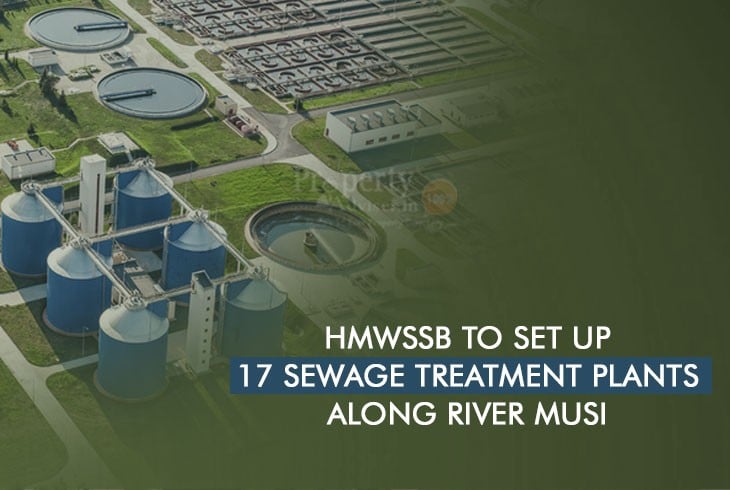
The Hyderabad Metropolitan Water Supply & Sewerage Board (HMWSSB) has started work on the establishment of 17 Sewage Treatment Plants (STP) along the River Musi and on the Kukatpally Nala catchment with a total treatment capacity of 376.5 million litres per day (MLD) as part of its efforts to ensure the flow of treated water into Hussain Sagar and to decentralize sewage treatment in the city.
Under the sewerage improvement project and the Sewerage Master Plan of the Hyderabad Urban Agglomeration area, the initiative is being taken up as part of the Hussain Sagar catchment development.
Plans to Develop 17 STPs Along River Musi
The Kukatpally Nala is one of the major inflow channels into the Hussain Sagar, aside from the Banjara, Picket and Balkapur nalas. About 155 MLD of sewage water flows through the Kukatpally Nala into Hussain Sagar. A lot of garbage, plastic waste and other waste flow into the lake through the Nala, along with sewage.
KT Rama Rao, Minister of Municipal Administration and Urban Development, instructed the HMWSSB to implement steps to stop the flow of sewage and ensure the flow of clean water from the Nala. Actually, by 25 STPs in various areas, HMWSSB handles 772 MLD of wastewater.
Officials stated that although most cities are only equipped to treat 20 to 30 percent of the sewerage created, nearly 43 percent of the HMWSSB is treated in the area. Almost 1,781 MLD of sewage is created in the Greater Hyderabad Municipal Corporation (GHMC) limits, of which about 772 MLD is handled through the STPs of the HMWSSB.
The concept is to decentralize the city's treatment of stagnant water. The sewage water is currently treated at Amberpet, Nagole and other STPs. HMWSSB is now working on the construction, installation, testing and commissioning of 17 STPs with a total capacity of 376.5 MLD under this initiative.
Such STPs will be equipped with process technology for sequential batch reactors and will arrive at different locations. As part of the agreements, the warranty period for equipment and instrumentation for the entire unit shall be 2 years from the date of commissioning of the plant, including manning, operation and maintenance for 15 years.
More specifically, as STPs are located near the foreshore of water bodies, the foundation of all the units will be designed in a way to facilitate upliftment in the future.
By: Shailaja K